One Rep Max Calculator: estimate your 1RM from a hard set
100 kg for 5 hard reps puts your max at about 112–119 kg: this one rep max calculator runs seven formulas, averages them (115.5 kg) and turns the result into training weights and plates per side.
One rep max calculator
- Enter a hard set you just did.
- Press Calculate 1RM.
- Tap a percentage to see the plates.
Your max goes on the poster
Enter a hard set and press Calculate 1RM: the estimated max, your training percentages and the loaded bar appear here.
Estimated 1RM
0lb
Range across formulas:
Rep-based formulas tend to underestimate the deadlift.
Next: most working sets of 5–8 reps sit at 75–85 % — tap a row below to load the bar.
An estimate from one set, not a tested max: warm up well and use spotters or safety bars for heavy singles.
| %1RM | Weight | Loaded | Typical reps |
|---|
| Reps | Weight | Loaded | %1RM |
|---|
| Formula | 1RM | Spread |
|---|
Recent estimates
Saved only in this browser. Tap an entry to load it again.
Getting a reliable result from a one rep max calculator
A one rep max calculator is only as honest as the set you give it. Pick a set of 3–8 reps that was genuinely hard: the last rep slowed down, your form held, and you had one more rep in you at most. Enter the Weight lifted, the Reps and the Lift, then press Calculate 1RM.
- Use a hard set. If you racked the bar with reps to spare, set Reps left in the tank (RIR) honestly. Five reps with two left counts as seven reps to failure. The guide to RPE and reps in reserve shows how to judge that number.
- Stay between 3 and 8 reps. Validation studies keep finding tighter predictions from low-rep sets; in Reynolds and colleagues' comparison a 5RM predicted the max best, and accuracy dropped with 10RM and 20RM tests. Above 10 reps the calculator shows a warning because the formulas spread apart.
- Compare like with like. A paused bench and a touch-and-go bench, or a high-bar and a low-bar squat, have different maxes. Estimate each variation on its own.
- Use a fresh set. A top set done after five back-off sets will underestimate you.
Worked example. You bench 100 kg for 5 reps to failure. Epley gives 100 × (1 + 5/30) = 100 × 1.1667 = 116.67 kg. Brzycki gives 100 × 36 / (37 − 5) = 100 × 1.125 = 112.50 kg. The other five formulas land between 113.71 and 119.01 kg. Their mean is 115.49 kg, which the result shows as Estimated 1RM 115.5 kg with a Range across formulas of 112.5 – 119 kg. I would plan training off 115.5 and treat 119 as a best-case day.
The seven one rep max formulas compared
Every formula takes the same two inputs, weight and reps to failure, and multiplies the weight by a factor that grows with the reps. They differ in how fast that factor grows. At 5 reps all seven agree within 6.5 kg, under 6 % of the max. At 15 reps they disagree by almost 44 lb, more than 20 % of the max. Open the All formulas tab to see your own set laid out this way, sorted from lowest to highest; tap a formula name there to switch the result to it.
| Formula | 1RM | 100 kg × 5 | 135 lb × 15 |
|---|---|---|---|
| Epley | w × (1 + r/30) | 116.67 kg | 202.50 lb |
| Brzycki | w × 36 / (37 − r) | 112.50 kg | 220.91 lb |
| Lombardi | w × r0.10 | 117.46 kg | 176.99 lb |
| Mayhew | 100w / (52.2 + 41.9e−0.055r) | 119.01 kg | 191.32 lb |
| O'Conner | w × (1 + 0.025r) | 112.50 kg | 185.62 lb |
| Wathen | 100w / (48.8 + 53.8e−0.075r) | 116.58 kg | 203.72 lb |
| Lander | 100w / (101.3 − 2.67123r) | 113.71 kg | 220.47 lb |
| Average of 7 formulas | mean of the seven | 115.49 kg | 200.22 lb |
| Range across formulas | lowest – highest | 112.50 – 119.01 kg | 176.99 – 220.91 lb |
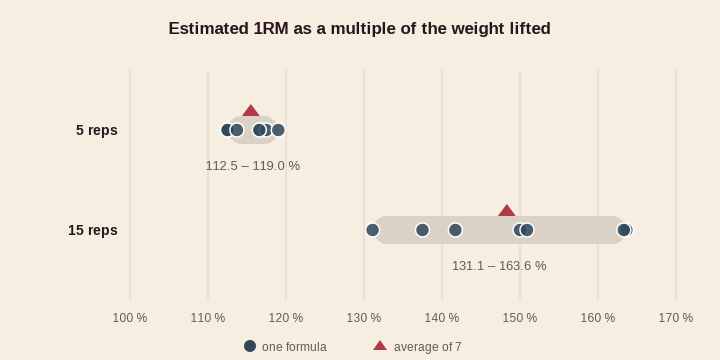
Which formula should you trust?
None of them is a law of nature. Epley's equation came from a poundage chart in a University of Nebraska training manual, and Brzycki's from a practical article for coaches; neither was published with a tested sample. Mayhew and colleagues did fit theirs to data: 435 college students on the bench press. Lander, O'Conner, Lombardi and Wathen come from manuals, textbook chapters and small datasets. A review of the 1RM prediction literature describes these origins and their limits.
Three findings matter in practice:
- When LeSuer and colleagues tested seven equations on 67 untrained students, predicted and real maxes correlated strongly (r > 0.95) for the bench press, squat and deadlift. Even so, every equation significantly underestimated the deadlift. Treat a deadlift estimate as a floor; the calculator reminds you when you pick Deadlift.
- Epley and Brzycki give identical results at 10 reps (100 kg × 10 → 133.33 kg). Below 10, Epley reads a little higher.
- Estimates can miss a real max by 10 % or more, as the Wikipedia overview of one-repetition maximum notes, and the error grows with reps.
My recommendation: leave the formula on Average of 7 formulas and read the range alongside it. If you have tested a true max before, check which formula came closest for that lift and keep using it. Personal fit beats any study average.
Percentages of your 1RM for training
The Percentages tab lists 50–100 % of your estimate in 5 % steps. Weight is the exact figure and Loaded is that weight rounded to your Round to step, so you can put it on the bar. Typical reps follows the NSCA training load chart (adapted from Landers): 95 % ≈ 2 reps, 85 % ≈ 6 reps, 75 % ≈ 10 reps.
| %1RM | Typical reps | Weight | Loaded | Weight | Loaded |
|---|---|---|---|---|---|
| 100 % | 1 | 115.5 kg | 115 kg | 259.9 lb | 260 lb |
| 95 % | 2 | 109.7 kg | 110 kg | 246.9 lb | 245 lb |
| 90 % | 4 | 103.9 kg | 105 kg | 233.9 lb | 235 lb |
| 85 % | 6 | 98.2 kg | 97.5 kg | 220.9 lb | 220 lb |
| 80 % | 8 | 92.4 kg | 92.5 kg | 207.9 lb | 210 lb |
| 75 % | 10 | 86.6 kg | 87.5 kg | 194.9 lb | 195 lb |
| 70 % | 12 | 80.8 kg | 80 kg | 181.9 lb | 180 lb |
| 65 % | 12+ | 75.1 kg | 75 kg | 168.9 lb | 170 lb |
| 60 % | 12+ | 69.3 kg | 70 kg | 155.9 lb | 155 lb |
| 55 % | 12+ | 63.5 kg | 62.5 kg | 142.9 lb | 145 lb |
| 50 % | 12+ | 57.7 kg | 57.5 kg | 129.9 lb | 130 lb |
Worked example in pounds. 225 lb × 5 gives an average of 259.85 lb. 80 % of that is 0.80 × 259.85 = 207.88 lb, which rounds to 210 lb at a 5 lb step. Many programs use a training max of about 90 % of the estimate instead of the estimate itself: 0.90 × 259.85 = 233.87 lb, so you would load 235. Rough guide: 80–90 % for sets of 2–6 builds strength, 65–80 % for 6–12 builds muscle, and 50–65 % is for technique and speed work. People get more reps at the same percentage on the squat than on the bench press, so treat the reps column as a starting point.
Under the tables, Copy table puts the open table on your clipboard for a spreadsheet or notes, Share link copies a link that reopens this exact result, and Print gives you a sheet for the gym. Your last ten results stay under Recent estimates, saved only in this browser: tap one to load it again, or use Clear history.
From percentage to plates on the bar
Tap any row of Percentages or Rep maxes: the barbell on the result is redrawn for that weight and the Plates per side panel lists what goes on each side. Choose your Bar (or Custom for a bar you have weighed), tick Collars 2 × 2.5 kg in kilogram mode if you use competition collars, and the calculator works out each side as (loaded − bar − collars) / 2, filling from the heaviest plate down. If an odd custom bar leaves weight the plates cannot make up, it tells you and shows what is really on the bar.
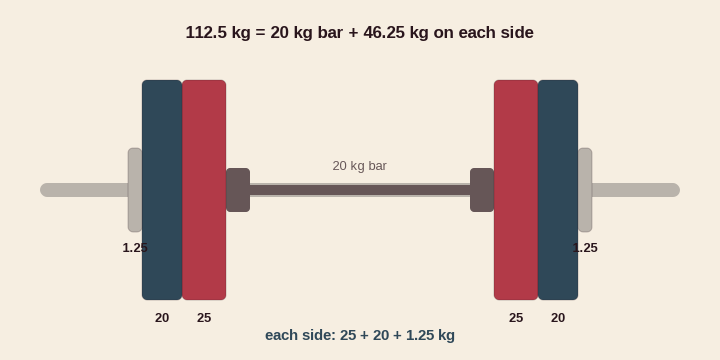
Kilograms: 112.5 kg on a 20 kg bar is (112.5 − 20) / 2 = 46.25 kg per side, which is 25 + 20 + 1.25. With collars, 140 kg is (140 − 20 − 5) / 2 = 57.5 kg per side: 25 + 25 + 5 + 2.5. Pounds: 225 lb on a 45 lb bar is (225 − 45) / 2 = 90 lb per side, two 45s. Keep in mind that a 45 lb bar weighs 20.41 kg, not 20. More on bars, plate colours and mixed kg/lb gyms in how much a barbell weighs.
Where the numbers come from
Here is what the calculator does with your inputs:
- Reps to failure = Reps + Reps left in the tank (RIR), 20 at most. A single counts as your max, so every formula returns the weight itself at 1 rep.
- Pounds and kilograms convert with 1 lb = 0.45359237 kg exactly. 225 lb is 102.06 kg, and 100 kg is 220.46 lb.
- The average is the plain mean of the seven formulas. The range is their lowest and highest values.
- Rep maxes runs each formula backwards: the weight you could lift for r reps is 1RM divided by that formula's factor for r reps.
- Loaded rounds half up to the nearest step (2.5 or 5 kg, 5 or 10 lb), so 57.75 kg becomes 57.5 and 69.29 kg becomes 70.
I checked the results against these reference cases, each worked out independently:
| Input | Result |
|---|---|
| 100 kg × 5, Average of 7 formulas | 115.5 kg; range 112.5 – 119 kg |
| 225 lb × 5, Average of 7 formulas | 259.9 lb (Epley 262.5, Brzycki 253.1) |
| 100 kg × 10, Epley or Brzycki | 133.3 kg from both; the average is 131.0 kg |
| 140 kg × 1, any formula | 140 kg: a single is already a max |
| 100 kg × 5 with 2 reps in reserve | 7 reps to failure → 121.6 kg (Epley 123.3) |
| 135 lb × 15 | 200.2 lb, range 177 – 220.9 lb, plus the high-rep warning |
| 85 % of 115.49 kg, Round to 2.5 kg | 98.17 kg → Loaded 97.5 kg |
| 3-, 5-, 10- and 12-rep maxes from a 115.49 kg 1RM, Average | 105.7, 100, 88.2 and 84.1 kg |
| 225 lb switched to kg | 102.06 kg, estimate 117.9 kg |
| 112.5 kg on a 20 kg bar | 25 + 20 + 1.25 kg per side |
| 315 lb on a 45 lb bar | 45 + 45 + 45 lb per side |
| 115 kg on a custom 18 kg bar | 25 + 20 + 2.5 kg per side; 2 kg can't be matched, so 113 kg is on the bar |
All of this is general information for planning training, not medical advice. If you have an injury or a health condition, get cleared by a professional before you lift near your max. For a real max attempt, follow the warm-up and safety steps in how to test your one rep max safely.
Guides
 How to test your one rep max safelyWhen a max test is worth it, a set-by-set warm-up ramp, how big to jump between attempts and how to stay safe on each lift.6-minute read
 RPE and reps in reserve: lifting by effortRPE 8 means two reps left. Learn the scale, calibrate your calls and see how reps in reserve change your estimated max.5-minute read
 How much does a barbell weigh? Plates per side in kg and lb20 kg or 45 lb? Bar weights, plate colours, collars, and plates per side for common totals in kilograms and pounds.5-minute read
Questions and answers
How accurate is a one rep max calculator?
From a hard set of 3–8 reps the formulas usually agree within about 5–6 % of each other, and a real max typically lands near that range. From 12 or more reps the spread passes 20 %, and the deadlift tends to be underestimated.
How many reps should I use to estimate my max?
A set of 3–8 reps taken to or close to failure. A 5-rep set is a good default; above 10 reps the estimate becomes rough.
Which 1RM formula is the most accurate?
No single formula wins for every lifter and lift. The average of seven with its range is the safest default; if you know your tested max, keep the formula that matched it best.
How often should I retest my 1RM?
Estimate from a top set every week or two while training. Test a true max a few times a year at most, for example at the end of a training block or before a meet.
What is a training max?
A working number set below your max, usually about 90 % of it, that programs like 5/3/1 base their percentages on. From a 259.9 lb estimate, that is about 235 lb.
Updated · About this site