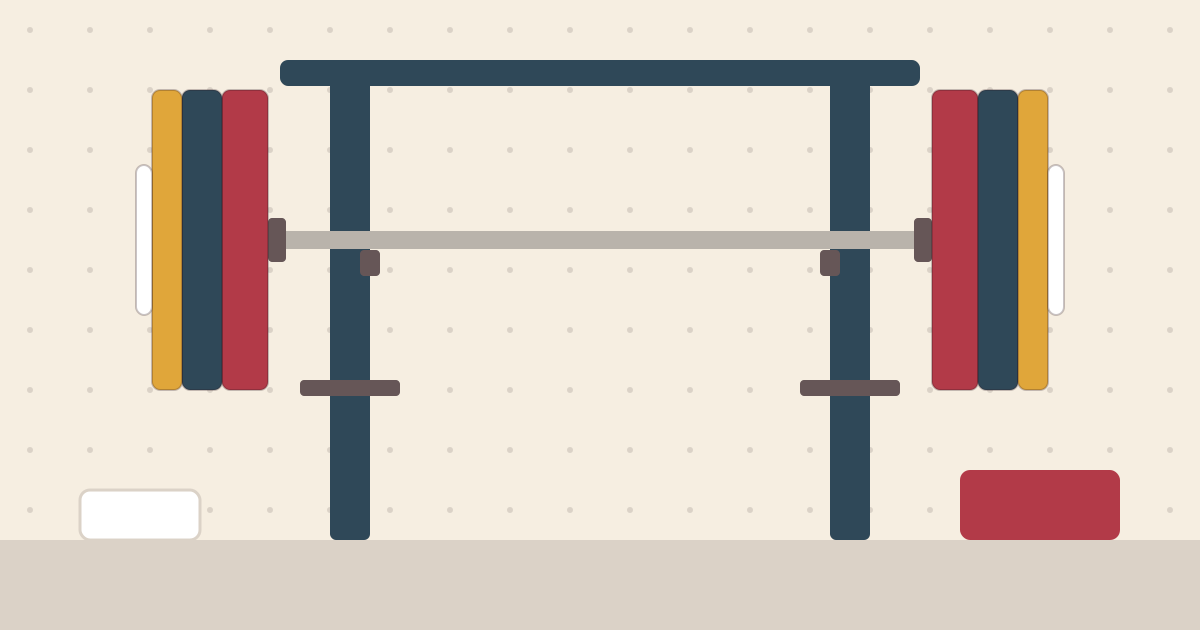
An Olympic barbell weighs 20 kg (44.09 lb); the standard US bar weighs 45 lb (20.41 kg). Get the bar wrong and every percentage you load is off before the first plate goes on.
How much does a barbell weigh?
Competition bars are built to exact weights, so if your gym has proper Olympic or powerlifting bars you can trust the number. Everything else deserves a quick check on a scale.
| Bar | Kilograms | Pounds | Where you meet it |
|---|---|---|---|
| Men's Olympic / powerlifting bar | 20 kg | 44.09 lb | Competition bars, most kg gyms |
| Women's Olympic bar | 15 kg | 33.07 lb | Weightlifting, many kg gyms |
| Standard US barbell | 20.41 kg | 45 lb | Most US commercial gyms |
| Women's / technique bar (lb) | 15.88 kg | 35 lb | US gyms |
| Training or technique bar | 10 kg or 6.80 kg | 22.05 lb or 15 lb | Coaching beginners, youth lifting |
| Trap bar, safety squat bar, EZ bar | varies | varies | Check the label or weigh it |
In the one rep max calculator the Bar list offers 20 kg, 15 kg and 10 kg in kilogram mode, and 45 lb, 35 lb and 15 lb in pound mode. Pick Custom for a trap bar or any bar you have weighed yourself.
Plate colours and sizes
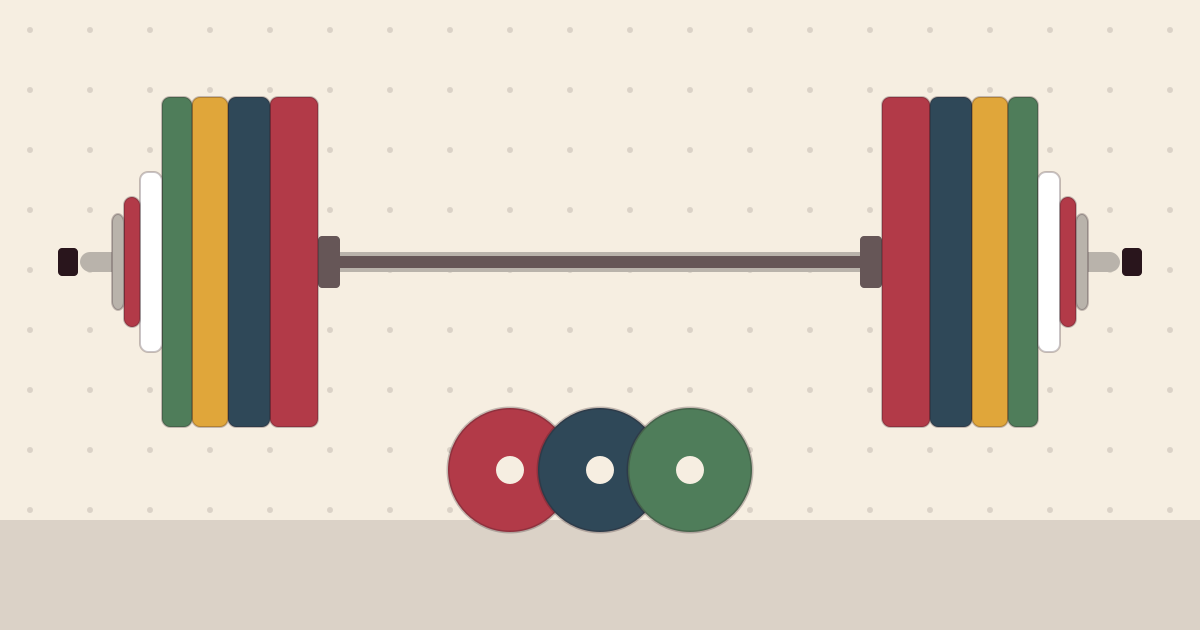
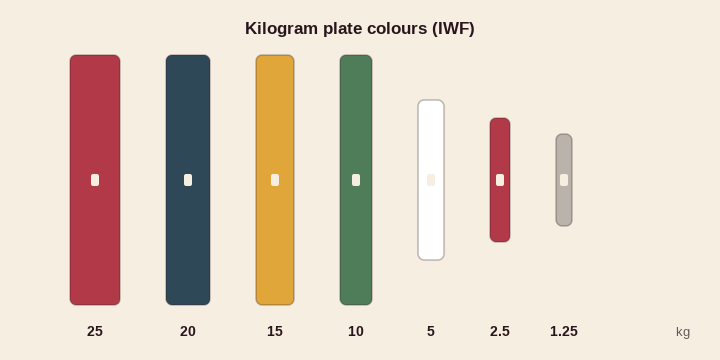
Kilogram bumper and competition plates follow the colour code in the IWF technical rules: 25 kg red, 20 kg blue, 15 kg yellow, 10 kg green, 5 kg white. The big discs share one diameter, 450 mm, so the bar sits at the same height off the floor whatever the load. Change plates are smaller: 2.5 kg is usually red, and many gyms add a silver or chrome 1.25 kg. Competition collars weigh 2.5 kg each, so a pair adds 5 kg.
Pound plates rarely follow a colour code. Most are black iron or black bumpers in 45, 35, 25, 10, 5 and 2.5 lb, with the weight cast on the face.
Plates per side: the math
- Subtract the bar from the total, and the collars if you use them.
- Divide by two: that is the weight for each side.
- Fill each side from the heaviest plate down until nothing is left.
Example in kilograms. 140 kg with competition collars: (140 − 20 − 5) / 2 = 57.5 kg per side, which is 25 + 25 + 5 + 2.5. Without collars the same 140 kg is (140 − 20) / 2 = 60 kg per side: 25 + 25 + 10. Example in pounds. 185 lb: (185 − 45) / 2 = 70 lb per side, which is 45 + 25.
| Total | Each side |
|---|---|
| 40 kg | 10 |
| 60 kg | 20 |
| 80 kg | 25 + 5 |
| 100 kg | 25 + 15 |
| 112.5 kg | 25 + 20 + 1.25 |
| 140 kg | 25 + 25 + 10 |
| 140 kg with 2 × 2.5 kg collars | 25 + 25 + 5 + 2.5 |
| 180 kg | 25 + 25 + 25 + 5 |
| Total | Each side |
|---|---|
| 95 lb | 25 |
| 135 lb | 45 |
| 185 lb | 45 + 25 |
| 225 lb | 45 + 45 |
| 275 lb | 45 + 45 + 25 |
| 315 lb | 45 + 45 + 45 |
| 405 lb | 45 + 45 + 45 + 45 |
If your gym has no 15 kg plates, 100 kg becomes 20 + 20 per side instead of 25 + 15. The total is the same; only the stack changes. The calculator's Plates per side panel does this for any row you tap, and the barbell on the result is drawn in the IWF colours (pound plates as black iron). With a Custom bar that leaves an odd remainder, it tells you which part can't be matched and what is really on the bar.
Kilogram and pound mix-ups
Mixed gyms cause most loading mistakes. Three I see again and again:
- "Two plates" is not the same everywhere. On a 45 lb bar with two 45s per side you lift 225 lb (102.06 kg). The same look with 20 kg plates on a 20 kg bar is 100 kg (220.46 lb): about 4.5 lb lighter.
- Red is not 45. A red 25 kg bumper weighs 55.12 lb. Four of them on a 45 lb bar, loaded by someone who thinks they are 45s, make 265.5 lb instead of 225.
- The bar is not always 20. A 45 lb bar counted as 20 kg loses 0.41 kg. That is harmless, but a 15 kg women's bar counted as 20 kg puts every set 5 kg off.
Set the calculator's kg / lb switch to match your plates, not your habit. Switching converts the weight field, the bar list and the rounding step together, so the plates it suggests are ones that exist in your gym.
Calibrated and uncalibrated plates
Competition plates are calibrated to the marked weight; cheap iron plates and worn bumpers can be noticeably off, and the error adds up across a full bar. For everyday training it rarely matters, because you load the same plates each week and the error stays constant. Before a max test, or when you move between gyms, weigh the plates you plan to use for the top sets, or at least the bar. That way a new personal best is real and not a lighter set of plates.
Rounding to weights you can actually load
A percentage of your max rarely lands on a weight you can build. 85 % of 115.49 kg is 98.17 kg; the bar cannot hold that. Round to fixes the step:
- 2.5 kg needs 1.25 kg plates (two of them make the 2.5 kg step). 98.17 kg loads as 97.5 kg.
- 5 kg is for gyms whose smallest plate is 2.5 kg.
- 5 lb needs 2.5 lb plates; 10 lb is for gyms that stop at 5 lb plates.
Rounding is half up, so a weight exactly halfway always goes to the heavier option. For a heavy single, the difference never exceeds half a step. If you are about to test a true max, the warm-up guide uses these rounded numbers for every set. The RPE guide shows how to pick top-set weights on days you train by effort.
Questions and answers
Is an Olympic bar 45 lb or 20 kg?
A men's Olympic bar is 20 kg, which is 44.09 lb. US gyms usually use 45 lb bars, which weigh 20.41 kg. The difference is small but adds up when you mix units.
How many plates per side for 100 kg?
On a 20 kg bar you need 40 kg per side: 25 + 15, or 20 + 20 if there are no 15 kg plates.
Do collars count toward the weight?
Yes. Competition collars weigh 2.5 kg each, 5 kg for the pair, and count toward the total. Light spring clips are usually ignored in training.