Most lifters never need to test a true one rep max: a hard set of 3–5 reps and a calculator get you within a few percent. When you do test, the warm-up decides the result more than the attempt itself, and a sloppy ramp is how people get hurt.
When a max test is worth it
A tested max is worth the fatigue and the risk when you have a reason to know the exact number:
- you compete and need to choose attempts, or you want to rehearse a meet day;
- your program asks for a tested 1RM, not an estimate;
- a training block just ended, you feel fresh, and you want a benchmark before the next one.
It is not worth it in your first months of lifting, when technique still changes week to week and every session is a personal best anyway. It is also not worth it in the middle of a hard block, or when you are coming back from a layoff or an injury. In those cases put a heavy set of 3–5 into the one rep max calculator and train off the estimate. If you stopped short of failure, add the reps you had left using the reps in reserve input.
Testing a max is general fitness information here, not medical advice. If you have a heart, blood pressure or joint condition, or any pain in the lift, get cleared by a professional before you go near 100 %.
Set up before the first warm-up
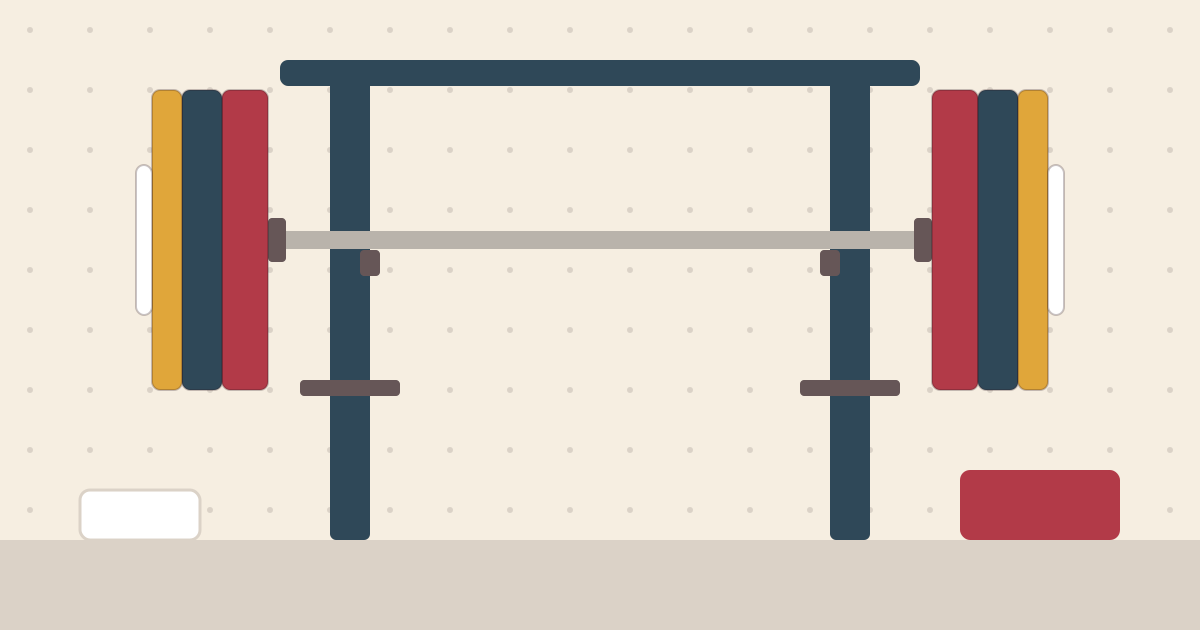
Safety equipment goes in place while the bar is still empty, not after your 90 % single.
- Bench press. This is the lift that traps people. Use a spotter who stands behind you, gives a hand-off and keeps both hands near the bar, or bench inside a rack with safety arms set just below your chest at the bottom. Wrap your thumbs around the bar.
- Squat. Squat in a rack with the safety pins or straps a few centimetres below your deepest bar position, and practise missing a rep onto them with the empty bar. Two side spotters or one behind is fine if they know what they are doing.
- Deadlift. No spotter is needed, but decide in advance that a rep where your back rounds badly gets put down, not ground out.
- Overhead press. Press inside a rack with the safeties at about chest height, so a missed rep can come down in front of you onto them.
Weigh the bar if you are not sure what it is, and check that your plates are all kilograms or all pounds. The barbell and plate loading guide covers the usual mix-ups.
The warm-up ramp
Base the ramp on your current estimate, not on a number you hope for. The pattern I use: many reps when the bar is light, singles as it gets heavy, and longer rests as you go.
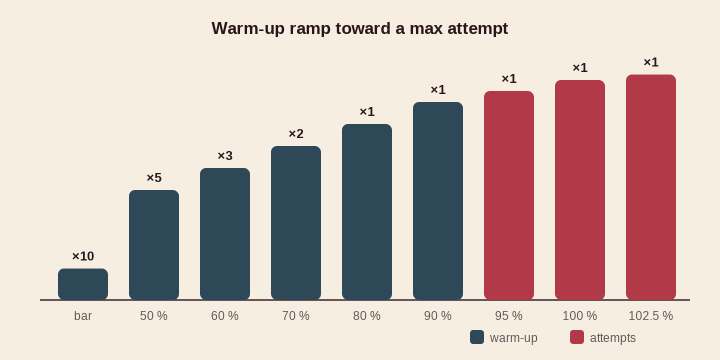
- Empty bar, 10 reps. Groove the path and find your grip and stance.
- About 40–50 % for 5. Fast and crisp. If this feels heavy, today is not a test day.
- About 60–70 % for 2–3. Two sets here if you need them. Stop well before fatigue.
- About 80 % for a single. Treat it like a max: full setup, brace, same breathing.
- About 90 % for a single. This one tells you how the day is going. It should move with clear speed.
- Attempts. First attempt at about 95 % of the estimate, second at the estimate, third only if the second was solid.
| Set | % of estimate | 140 kg max | 315 lb max | Reps | Rest after |
|---|---|---|---|---|---|
| 1 | empty bar | 20 kg | 45 lb | 10 | 1 min |
| 2 | 50 % | 70 kg | 160 lb | 5 | 2 min |
| 3 | 60 % | 85 kg | 190 lb | 3 | 2 min |
| 4 | 70 % | 97.5 kg | 220 lb | 2 | 2–3 min |
| 5 | 80 % | 112.5 kg | 250 lb | 1 | 3 min |
| 6 | 90 % | 125 kg | 285 lb | 1 | 3–4 min |
| 7 · attempt 1 | about 95 % | 132.5 kg | 300 lb | 1 | 4–5 min |
| 8 · attempt 2 | 100 % | 140 kg | 315 lb | 1 | 4–5 min |
| 9 · attempt 3 | about 102.5 % | 142.5 kg | 325 lb | 1 | done |
The weights above are rounded the way the calculator rounds them: 90 % of 315 lb is 283.5 lb, which loads as 285. You can build the same ramp for your own estimate from the Percentages tab and tap each row to see the Plates per side.
Choosing jumps between attempts
Let the 90 % single decide your attempts. If it flew up and felt like you had three reps left, go to your planned numbers. If it was slow, take the first attempt at 92–93 % and treat a smooth rep there as a good day.
Between attempts, jump 2.5–5 kg (5–10 lb) on the bench and overhead press, and 5–10 kg (10–20 lb) on the squat and deadlift. Jumps smaller than 2.5 kg need 1.25 kg change plates, which many gyms do not have. A grinder that takes three seconds through the sticking point is your max for the day: write it down and stop. A missed attempt also ends the session. A second try after a miss rarely goes up and often goes wrong.
What counts as a valid rep
A max only means something if you can repeat the standard next time. Use the same rules every test:
- Squat: the hip crease goes below the top of the knee, then you stand to full lockout.
- Bench press: the bar touches the chest without bouncing, your hips stay on the bench, and the arms lock out. Pause on the chest if you compete with a pause.
- Deadlift: hips and knees lock out together, with no resting the bar on the thighs to hitch it up.
- Overhead press: no leg drive and no big lean back; otherwise it is a push press, a different lift.
How often to test
A few times a year at most. Between tests, put your top set into the calculator every week or two: a rising estimate tells you the training works without the cost of a real max. After a test, many programs set a training max of about 90 % of the new number. A 140 kg squat gives a 126 kg training max, which loads as 125 kg. Expect estimates to underestimate your deadlift, as the overview of 1RM estimation and the studies it draws on point out.
Questions and answers
Is it safe to test a one rep max without a spotter?
On the squat and overhead press, yes, if you work inside a rack with safeties set correctly. On the bench press, use a spotter or safety arms; never max out on the bench alone without them.
How many warm-up sets do I need before a max?
Usually five or six: the empty bar, then about 50, 60–70, 80 and 90 % of your estimate, with reps falling from 10 to a single.
Should I test my 1RM or estimate it?
Estimate it most of the time from a hard set of 3–8 reps. Test a true max only when you need the exact number, for example before a meet, and only when you are fresh.