Five reps with 100 kg tells you a lot about your max, if you also know how many more you could have done. That number is called reps in reserve, and two of them move the estimate by about 6 kg.
The RPE scale in lifting terms
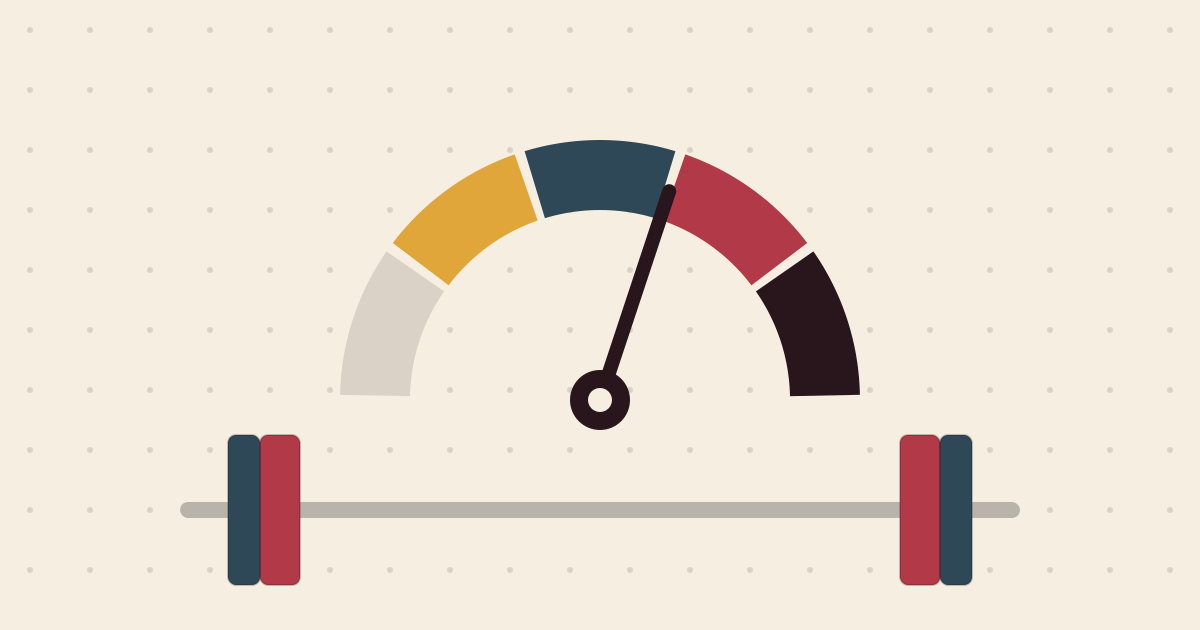
RPE (rate of perceived exertion) on a lifting scale runs from 1 to 10, and the useful part is 6 to 10. Each step is tied to a count of reps you had left, which makes it far easier to use than "how hard did it feel". This reps-in-reserve version of RPE was popularised in powerlifting by Mike Tuchscherer and later studied by Zourdos and colleagues.
| RPE | Reps in reserve | What the last rep feels like |
|---|---|---|
| 10 | 0 | Nothing left: another rep or more weight was impossible |
| 9.5 | 0 | No more reps, but a little more weight might have gone |
| 9 | 1 | One more rep was there |
| 8.5 | 1–2 | One rep for sure, maybe two |
| 8 | 2 | Two more reps were there |
| 7 | 3 | Bar still moves fast; three reps left |
| 6 | 4 | Clearly submaximal; four reps left |
| 5 and below | 5+ | Warm-up weight |
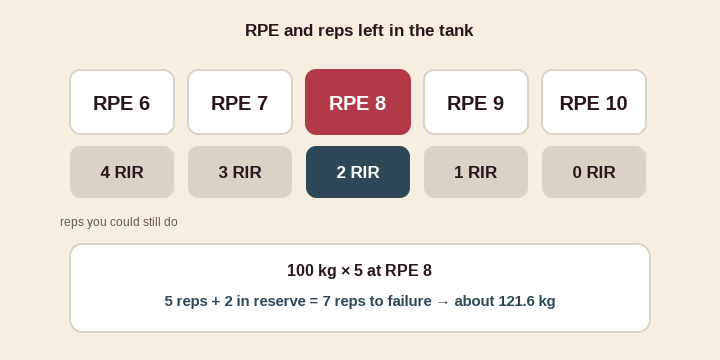
RIR is just the other side of the same coin: RPE 8 means 2 RIR, RPE 9 means 1 RIR. Programs written in RPE ("3 × 5 at RPE 8") and programs written in RIR ("leave 2 in the tank") ask for the same thing.
Why sets short of failure underestimate your max
Every 1RM formula assumes the reps you enter were the most you could do. Enter a set you stopped early and the formula thinks that was your limit, so it reads you as weaker than you are.
Worked example. You bench 100 kg for 5 at RPE 8. Entered as a plain 5-rep set, the average of seven formulas gives 115.49 kg. With 2 reps in reserve the calculator treats it as 5 + 2 = 7 reps to failure. Epley then gives 100 × (1 + 7/30) = 123.33 kg, and the average is 121.62 kg. The difference is 6.13 kg, about 5 %, which is the gap between a percentage table that fits and one that feels too light.
| Set | Reps in reserve | Reps to failure | Estimated 1RM |
|---|---|---|---|
| 100 kg × 5 | 0 | 5 | 115.5 kg |
| 100 kg × 5 | 2 | 7 | 121.6 kg |
| 102.5 kg × 5 | 2 | 7 | 124.7 kg |
| 315 lb × 3 | 0 | 3 | 344.3 lb |
| 315 lb × 3 | 1 | 4 | 354.1 lb |
How the reps in reserve input works
- Enter the set as you did it: Weight lifted and Reps.
- Set Reps left in the tank (RIR) to 0–4. The default, 0, means you could not have done another rep.
- Press Calculate 1RM. The result line spells it out, for example "5 reps + 2 in reserve = 7 reps to failure".
- Read the Percentages tab as usual; every row now comes from the corrected estimate.
Two limits are built in. Reps plus reserve cannot pass 20, because no formula is meaningful there. And reserve stops at 4: beyond that the set was a warm-up, and guesses that far from failure are poor. Treat the adjustment as an approximation, not a measurement. If you put 7 effective reps in, the usual high-rep caution still applies once the total passes 10.
Calibrating your own RIR
Most lifters, beginners especially, think they are closer to failure than they are. A set they call RPE 9 often had three reps left. You can check yourself safely:
- On a machine or a lift with safeties, call your RIR after rep 5, then keep going until you cannot complete a rep. If you said 2 and did 4 more, you under-call by two.
- Do this on the last set of an exercise, not the first, so a set to failure does not wreck the rest of the session.
- Avoid testing RIR to failure on the bench press without a spotter, or on any lift where your form breaks down near the end.
After a few checks your calls get accurate to about one rep, which is all the calculator needs.
Where RPE calls go wrong
- High-rep sets. On a set of 12–15 the burn and the heavy breathing make you feel finished long before your muscles are. Calls are most accurate on sets of 3–6.
- Heavy singles. A single at RPE 9.5 and one at 10 look the same from outside. Ask yourself one question afterwards: could you have added 2.5 kg and still made it?
- Squats and deadlifts. More muscle works and breathing gets hard, so a set of 8 at RPE 8 feels brutal. Judge the reps you had left, not how tired you are.
- Bar speed. The last rep before failure is usually much slower than the rest. If every rep moved at the same speed, you probably had more than two left.
Using RPE to set the day's weights
RPE lets the bar tell you what kind of day it is. A common pattern: work up to a top set at a target RPE, enter it, then take back-off sets from the new estimate.
Example. The plan says a top set of 5 at RPE 8. You hit 102.5 kg × 5 and judge 2 reps left. 102.5 kg for 7 reps to failure gives an average estimate of 124.66 kg. Back-off sets at 75 % of that are 93.49 kg, which loads as 92.5 kg. On a bad day the same RPE 8 might come at 95 kg, and the back-offs drop with it. That is the point: the effort stays constant, the load follows your readiness.
The same top sets, entered every week, give you a running estimate of your max without ever testing it. When you do want a real number, the guide to testing your max safely shows the warm-up. The one rep max calculator handles the conversion either way.
Questions and answers
What does RPE 8 mean in lifting?
You finished the set with about two reps left in reserve. RPE 9 means one rep left, and RPE 10 means none.
Should I always train to RPE 10?
No. Most working sets in strength programs sit around RPE 7–9; going to failure every set adds fatigue faster than it adds strength.
Is reps plus RIR exactly the same as a set to failure?
It is an approximation. Fatigue builds unevenly in the last reps, and RIR guesses are rarely perfect, so treat the corrected estimate as a close guide.